Showing posts with label brain. Show all posts

Monday, January 19, 2009

Anatomically Explicit Cake

The Cake Wrecks site posted some swell anatomically explicit cakes last week. Unlike the treats made by some bakeries, these are actually safe for work. At least my work.

These cake decorators are welcome to make a birthday cake for me anytime. That is, assuming they can find enough gray icing to make a proper radiology cake...

(via Anita Anderson)

Monday, December 22, 2008

MRI = Mind Reading Imaging?

Can you read someone's mind with magnetic resonance imaging (MRI)?

The short answer is: yes, of course -- we've done it for years.

However, don't get too spooked. The stuff that we are able to read has so far been extremely limited.

Consider the book as a metaphor for a brain. Until recently, we've only been able to read the shape of the book. However, functional magnetic resonance imaging (fMRI) has advanced to the point that we can now read some of the Cliff Notes of that book as well.

The latest issue of Neuron describes some fascinating work by Miyawaki et al: Visual Image Reconstruction from Human Brain Activity using a Combination of Multiscale Local Image Decoder. In this study, the authors presented simple visual patterns to volunteers. The authors were then were able to reconstruct the patterns seen from the volunteers' brains using fMRI. Check out the following reconstructed images:


As Michael Russell commented:
It looks like the JPEG compressor in the test subject's brain is set WAAAY too high.
Agreed. Even so: Wow.

The keys to this god-like power are topological maps of the cerebral cortex, such as the well-known sensory and motor homunculi first mapped out by Wilder Penfield.


It turns out that there are also retinotopic maps, connecting retinal stimuli to certain areas in the visual cortex. By imaging functional information directly from volunteers' occipital lobes with fMRI, Miyawaki et al were able to use such retinotopic maps to reconstruct what the subjects saw.

At the moment, it takes a lot of time and equipment to pull off this kind of mind-reading. So, by the time your coworker realizes that you've been undressing them in your mind, you will have already put their clothes back on and decided that they look a lot better that way.

In any event, this procedure will probably only work on information from the sensory and visual cortices, i.e. stuff that you are currently feeling or seeing. It won't work with stuff you are thinking or remembering.

No matter how many medical and legal uses we find for this technology, adolescent males of all ages will immediately leap to more prurient applications. What could horny geeks do with direct visual and sensory recording technology? The internet porn industry immediately comes to mind (so to speak).

For the moment it will be fairly easy to spot fMRI voyeurs -- just look for someone aiming a 7 foot ** roll of toilet paper at your skull. So, until this technology becomes a lot more portable, I won't be guarding my thoughts too closely. Sadly (or gladly), it will be a long time before nerds with iPhones can pull this off. However, that won't stop us from fantasizing about it...

(via Pharyngula)


** the approximate diameter of your typical fMRI scanner

Monday, October 13, 2008

The Banjo Center of the Brain

I've used my banjo in a number of venues, but I've never brought it in to work. Looks like some Nashville neurosurgeons have beat me to it.

Bluegrass legend Eddie Adcock recently underwent brain surgery to treat a hand tremor. During this procedure, his surgeons placed electrodes deep into his brain to stimulate the thalamus at just the right spot to inhibit his tremor.

Alas, the banjo center of the brain is not an area well-known to neuroanatomists. To pick the optimal location for the electrodes, the surgery was performed under local anesthesia while Eddie played his banjo. He was thus able to update the surgeons in real-time as to whether the tremor was better or worse, letting them get the lead placement just right.


The BBC has posted some remarkable video and audio clips recorded during this surgery. The audio beginning at the 3:49 marker moved me the most. In this bit, the BBC interviewer asks Mr. Adcock to play the banjo with his stimulator on and off. The difference is pretty clear, even to the non-bluegrass ear.

Losing the ability to play is a special terror we musicians know, even for those of us who earn our living some other way. I went through this recently following a biceps tendon repair. The first few months were depressing for me because I couldn't bow my fiddle in my ginormous bionic elbow brace. However, once I was able to drape said brace over my guitar and play a few minutes every day, my spirits picked up considerably.

So, here's to the Vanderbilt neuro boys. There are a lot of musicians and music lovers out there who would happily line up to buy them a few drinks. If it would help us to play like Eddie Adcock, I know that several of us would also line up for our own set of electrodes.

(Hat tip to Anita Anderson)

Tuesday, September 16, 2008

Giant Animal Smasher May Discover Darwin Particle

As I reported here recently, scientists at CERN are now using the Large Hadron Collider in Geneva to probe atomic structure. Their quarry includes the elusive Higgs boson.

Physicians and other members of the soft sciences will be delighted to learn of progress on the Giant Animal Smasher, now under construction near Dallas, TX. As one CERN scientist stated:
Biologists are just jealous of all the attention the LHC has been getting. Since they aren't real scientists, they had to come up with this atrocity.
Much of the early work in animal smashing is anecdotal, and has largely been carried out informally by pickup and semi-trailer trucks on the roadways of the world. However, this important work has been greatly limited by local highway speed limits.


The GAS, however, can theoretically collide animals as large as squirrels at relative speeds of 12,000 meters per second. This device may thereby demonstrate evidence of the Darwin particle, unlocking the secrets of evolution and life.

Not to be discounted is
...the visceral enjoyment of seeing two squirrels collide at thousands of miles an hour.
Of course, if it's visceral enjoyment we're after, there's nothing like flinging actual viscera around. Luckily, we may not have to wait too long for this...
Next thing you know the psychologists will build a brain smasher to compete.
Among psychologists, I'm guessing that the schadenfreudians will be the first on board with this new tool.

(hat tip to David Goldman)

Friday, August 8, 2008

A Tale of Two Brains

One of my lifelong quests is to learn to give presentations that don't suck.

One tactic in this quest is to learn from people who give exceptional talks. A great source for awesome presentations is the TED conference, which hosts the best speakers in the world and shares them on the web.

In the following TED video, neuroscientist Jill Bolte Taylor gives a play by play account of her own stroke. There's a lot to learn here. Her insights from this devastating event are quite compelling. Equally compelling are the techniques she uses to tell this gripping tale of two brains.

Friday, May 23, 2008

These Naughty, Naughty Roentgen Rays

The official website of the Nobel Foundation has launched Imaging Life, an educational site showing how Nobel Prizes in scientific and medical imaging have affected medicine and popular culture.

Reactions in the media to the discovery of X-rays included the following bit of doggerel:
X-actly So!

The Roentgen Ray, the Roentgen Rays,
What is this craze?
The town's ablaze
With the new phase
Of X-ray's ways.

I'm full of daze,
Shock and amaze;
For nowadays
I hear they'll gaze
Thro' cloak and gown -- and even stays,
These naughty, naughty Roentgen Rays.
Once word of X-rays leaked out of the lab to the populace, it's interesting (and not too surprising) that one of the first applications they thought of was to look at naked ladies. Interest in this certainly hasn't waned -- if anything, we're even more obsessed with it now than ever.

Interestingly enough, this presentation has at least one notable omission: Egas Moniz, who won the Nobel Prize for Medicine in 1949. Although his prize was awarded for his work on prefrontal leucotomy (a.k.a lobotomy) for treatment of psychosis, he also pioneered the technique of cerebral angiography in 1927, and it has remained one of the premier methods of brain imaging ever since.

Thursday, May 1, 2008

Sex and Financial Risk Linked in Brain


There are probably few people who have not seen some version of this cartoon showing the differences between male and female brains.

Functional magnetic resonance imaging (fMRI) is beginning to uncover a much more realistic -- but no less wacky -- map of brain differences between men and women. For example, take the following report from the journal NeuroReport:
Knutson B, Wimmer GE, Kuhnen CM, Winkielman P. Nucleus accumbens activation mediates the influence of reward cues on financial risk taking. NeuroReport March 26, 2008 19(5):509-513.

The money quote (so to speak):
"...we predicted and found that anticipation of viewing rewarding stimuli (erotic pictures for 15 heterosexual men) increased financial risk taking..."
In other words, erotic pictures caused these men to take bigger monetary gambles than pictures of neutral (household appliances) or scary objects (snakes and spiders).

Who could have seen that coming? Let's just hope that the casinos and advertising agencies never get wind of this.

(via Chicago Tribune)

Thursday, March 6, 2008

Driving While Under the Influence of fMRI

What will someone cram into an fMRI machine next? Earlier this week I posted about the use of functional magnetic resonance imaging (fMRI) to study brain activity in keyboard musicians while they were improvising jazz. It would now appear that even drivers with cell phones are not safe from fMRI researchers.

Brain Research just posted an in-press manuscript titled: "A decrease in brain activation associated with driving when listening to someone speak".

Why was this study done?
"Behavioral studies have shown that engaging in a secondary task, such as talking on a cellular telephone, disrupts driving performance. This study used functional magnetic resonance imaging (fMRI) to investigate the impact of concurrent auditory language comprehension on the brain activity associated with a simulated driving task."
Despite the title of the article, they did not study actual driving -- the sheer size of a decent fMRI scanner precludes this. To see the difficulty, imagine driving down the road with a your head stuffed inside a roll of toilet paper that is 7 feet in diameter. By the way, the toilet paper roll also weighs several tons, and has magnetic and radio frequency fields strong enough to send a cell phone flying and frying. Understandably, the investigators chose to simulate driving and cell phone conversations by other means.
"Participants steered a vehicle along a curving virtual road, either undisturbed or while listening to spoken sentences that they judged as true or false. "
How did the simulated drivers do?
"The dual task condition produced a significant deterioration in driving accuracy caused by the processing of the auditory sentences. At the same time, the parietal lobe activation associated with spatial processing in the undisturbed driving task decreased by 37% when participants concurrently listened to sentences."
The bottom line:
"The findings show that language comprehension performed concurrently with driving draws mental resources away from the driving and produces deterioration in driving performance, even when it does not require holding or dialing a phone."
This conclusion is not exactly a bolt from the blue -- they cite a number of other studies that echo the same conclusion: your driving sucks when you use a cell phone, hands-free or not.
For the full article, please see: Marcel Adam Just, Timothy A. Keller, Jacquelyn Cynkar. A decrease in brain activation associated with driving when listening to someone speak. Brain Research (2008), doi: 10.1016/j.brainres.2007.12.075.
(via MedPage Today)

Tuesday, March 4, 2008

Music Made Visible

Brain-only-fMRI-journal.pone.0001679.g003.pngHow and why did humans evolve the ability to make and hear music?
It's easy to understand how stronger muscles, sharper eyes and a smarter brain would be great survival traits. The capacity to speak makes evolutionary sense as well - just the ability to yell "Sabertooth on your left!" at the right time would be huge.

However, when we got speech, we also got a lot more than just the power to grunt a few simple words. It would seem that this skill came bundled with the ability to hear four-part harmonies and appreciate the counter-melodies of Bach. But how does that make any Darwinian sense?  What's the survival benefit of a sonata?  In The Cerebral Symphony, William Calvin opines:
I'll bet that music is going to turn out to be a secondary use of some neural structure selected for its usefulness in some serial-timing task like language or throwing -- and used in the off-hours for music.
In a recent PLOS paper, researchers used functional MRI (fMRI) to take a peek under the hood of the brains of jazz musicians.

Axial-Brains-journal.pone.0001679.g002.png

Axial slice renderings of mean activations (red/yellow scale bar) and deactivations (blue/green scale bar) associated with improvisation during Scale and Jazz paradigms. From: Limb CJ, Braun AR (2008) Neural Substrates of Spontaneous Musical Performance: An fMRI Study of Jazz Improvisation. PLoS ONE 3(2): e1679. doi:10.1371/journal.pone.0001679
An fMRI machine measures real-time changes in brain blood flow while a subject is doing something of interest. Hopefully, this changing blood flow also closely mirrors changes in local neural activity. The end result is a 3D map of which specific cerebral wheels, gears and pulleys are turning while one, say, takes a poop or improvises on a Bach fugue.

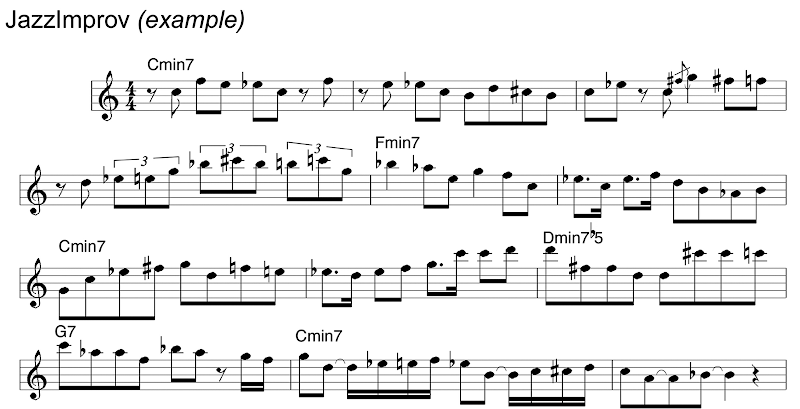
As a researcher, I was impressed with the authors' clever study design, which put 6 professional jazz pianists (one at a time, that is) into an fMRI machine with a non-ferromagnetic MIDI keyboard. They then recorded the MIDI output from this keyboard while creating simultaneous fMRI maps of brain activity. First, the musicians played a control piece: a simple one-octave C major scale in quarter notes. They were then asked to play an improvised melody, but were restricted to the use of C major scale quarter notes within the same octave. Next, they were asked to play a pre-memorized original jazz composition, in synchrony with a pre-recorded music-minus-one jazz quartet. Finally, they were allowed to cut loose and improvise freely with the pre-recorded accompaniment.

JazzImprov-journal.pone.0001679.g001-cropped.png

The authors conclude:
Our results strongly implicate a distinctive pattern of changes in prefrontal cortical activity that underlies the process of spontaneous musical composition. Our data indicate that spontaneous improvisation, independent of the degree of musical complexity, is characterized by widespread deactivation of lateral portions of the prefrontal cortex together with focal activation of medial prefrontal cortex. This unique pattern may offer insights into cognitive dissociations that may be intrinsic to the creative process: the innovative, internally motivated production of novel material (at once rule based and highly structured) that can apparently occur outside of conscious awareness and beyond volitional control.
As a radiologist, I'm delighted to see cool new uses of the machines I work with every day. When I started my career, we were happy just to be able to distinguish gray matter from white matter. It now appears that we are beginning to look at some of the nuts and bolts of creativity itself.

As a musician, a part of me will continue to nurse a small, Luddite hope that we don't discover all of the brain's secrets too quickly. After working with high tech gear all day, it's great solace to retreat to the atavistic pleasures of folk music and dance -- things I can enjoy even miles from electricity. For now, I'll continue to routinely deactivate major portions of my prefrontal cortex when I'm away from work, and let my instruments and my body move through the music on cerebellar cruise control alone.

(hat tip to Medgadget, whose post, This is Your Brain on Jazz, has a much better title than mine.)


Update, 3/5/08: This PLOS paper has just been featured in USA Today. To see what a keyboard player in an MR scanner looks like, see here.